
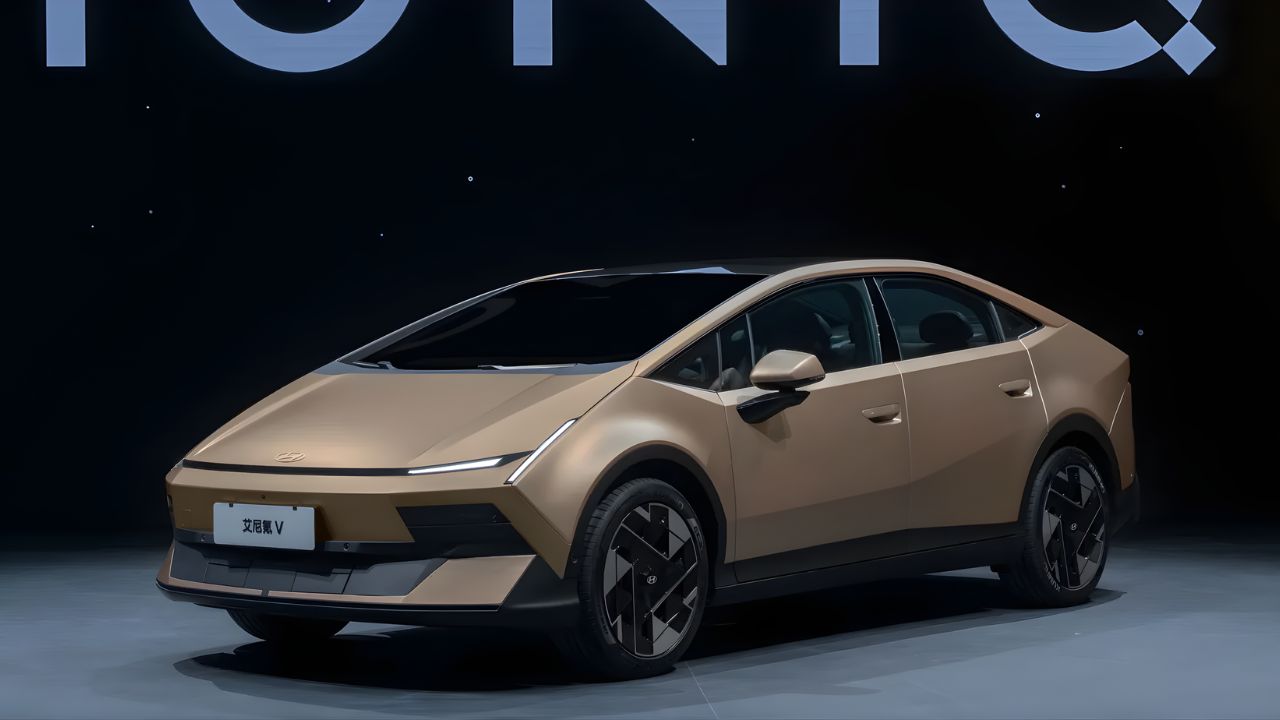
Hyundai has introduced the Ioniq V at Auto China 2026 as its first all-electric model developed specifically for the Chinese market.
Positioned as part of the company’s renewed strategy in the world’s largest EV segment, the Ioniq V draws heavily from the previously revealed Venus concept.
The liftback-style sedan reflects Hyundai’s effort to align design, technology, and performance with regional preferences while strengthening its competitiveness in China.
Design
The Ioniq V adopts Hyundai’s latest EV design philosophy, known as “The Origin.” The styling focuses on clean lines and a coupe-like silhouette, giving the car a streamlined yet substantial appearance. The overall shape balances aerodynamic efficiency with a premium visual presence.
At the front, the vehicle features full-LED lighting elements along with sharply defined daytime running lamps. Frameless doors and low-profile tyres contribute to a modern, upscale look.
The design approach appears consistent with current trends in the Chinese EV market, where emphasis is placed on both aesthetics and efficiency.
In terms of dimensions, the Ioniq V is sized to provide a strong road presence while maintaining interior space:
| Specification | Measurement |
|---|---|
| Length | 4,900 mm |
| Width | 1,890 mm |
| Wheelbase | 2,900 mm |
These proportions indicate a focus on passenger comfort and cabin space, particularly for rear occupants, which remains an important consideration in this segment.
Interior
The interior design closely follows the Venus concept, with minimal changes. The layout emphasizes simplicity and digital integration, with a focus on providing a connected and comfortable user experience.
A 27-inch 4K panoramic display spans the width of the dashboard, combining infotainment functions with vehicle information.
This large screen setup reduces the need for physical controls while centralizing key features. A wide-format head-up display is positioned in front of the driver to provide essential driving data without requiring the driver to look away from the road.
Additional features include a three-spoke touch-enabled steering wheel, ambient lighting, and an eight-speaker sound system equipped with Dolby Atmos technology. These elements are designed to enhance both usability and the in-cabin experience.
Hyundai has also highlighted the spaciousness of the cabin, with segment-leading measurements:
| Cabin Space | Measurement |
|---|---|
| Front Legroom | 1,078 mm |
| Rear Legroom | 1,019 mm |
| Front Shoulder Room | 1,502 mm |
| Rear Shoulder Room | 1,473 mm |
The extended wheelbase and flat floor architecture contribute to a more open layout. Hyundai describes the interior as having a lounge-like atmosphere, which aligns with current consumer preferences for comfort and flexibility in daily commuting.
Safety
Safety features in the Ioniq V include a reinforced body structure and a nine-airbag system. These elements are intended to provide a high level of occupant protection in various driving conditions.
The model is also equipped with an advanced driver assistance system developed in collaboration with Chinese technology company Momenta.
The system has been calibrated specifically for local traffic environments, which can vary significantly in density and driving patterns compared to other regions.
This localized approach is expected to improve the effectiveness of features such as adaptive cruise control, lane assistance, and automated emergency responses.
Range
Hyundai has stated that the long-range version of the Ioniq V is capable of delivering more than 600 km on the China Light-Duty Vehicle Test Cycle (CLTC). This figure places it competitively within its segment, where range remains a key consideration for buyers.
While detailed powertrain specifications, including motor output and acceleration figures, have not yet been disclosed, Hyundai has indicated that multiple variants will be offered. This is likely to include a lower-range version aimed at a broader price range.
The focus on efficiency and usable range suggests that the Ioniq V is intended for both urban commuting and longer intercity travel.
Platform
The Ioniq V is built on an 800-volt electrical architecture, developed in partnership with Beijing Automotive Group (BAIC). This high-voltage system supports faster charging and improved energy efficiency compared to conventional EV platforms.
Battery packs are supplied by CATL, a leading global battery manufacturer. The use of CATL batteries is expected to support reliability and performance, given the company’s established presence in the EV industry.
The 800-volt system enables rapid charging, reducing downtime and making the vehicle more practical for regular use. This feature aligns with the expectations of Chinese consumers, who increasingly prioritize convenience and charging speed.
Market
The Ioniq V is currently planned as a China-exclusive model. This market-specific approach allows Hyundai to tailor the vehicle’s features, design, and technology to local consumer demands.
China remains the largest and one of the most competitive EV markets globally, with domestic manufacturers playing a significant role in innovation and pricing.
Hyundai’s collaboration with local partners such as BAIC and Momenta reflects a strategic effort to integrate regional expertise into product development.
By focusing on localization, Hyundai aims to strengthen its position and respond more effectively to evolving market dynamics.
The Hyundai Ioniq V represents a targeted approach to electric mobility in China, combining design influence from concept models with practical features intended for everyday use.
Its emphasis on space, digital integration, and charging capability aligns with current market expectations.
While additional details such as pricing and performance figures are yet to be announced, the model indicates Hyundai’s continued commitment to expanding its EV portfolio in key global markets.
FAQs
What is the Hyundai Ioniq V?
A China-exclusive electric sedan by Hyundai.
What is its range?
Over 600 km on the CLTC cycle.
Where will it be sold?
It will be sold only in China.
What platform is used?
An 800V EV platform co-developed with BAIC.
Who supplies the battery?
CATL supplies the battery packs.