
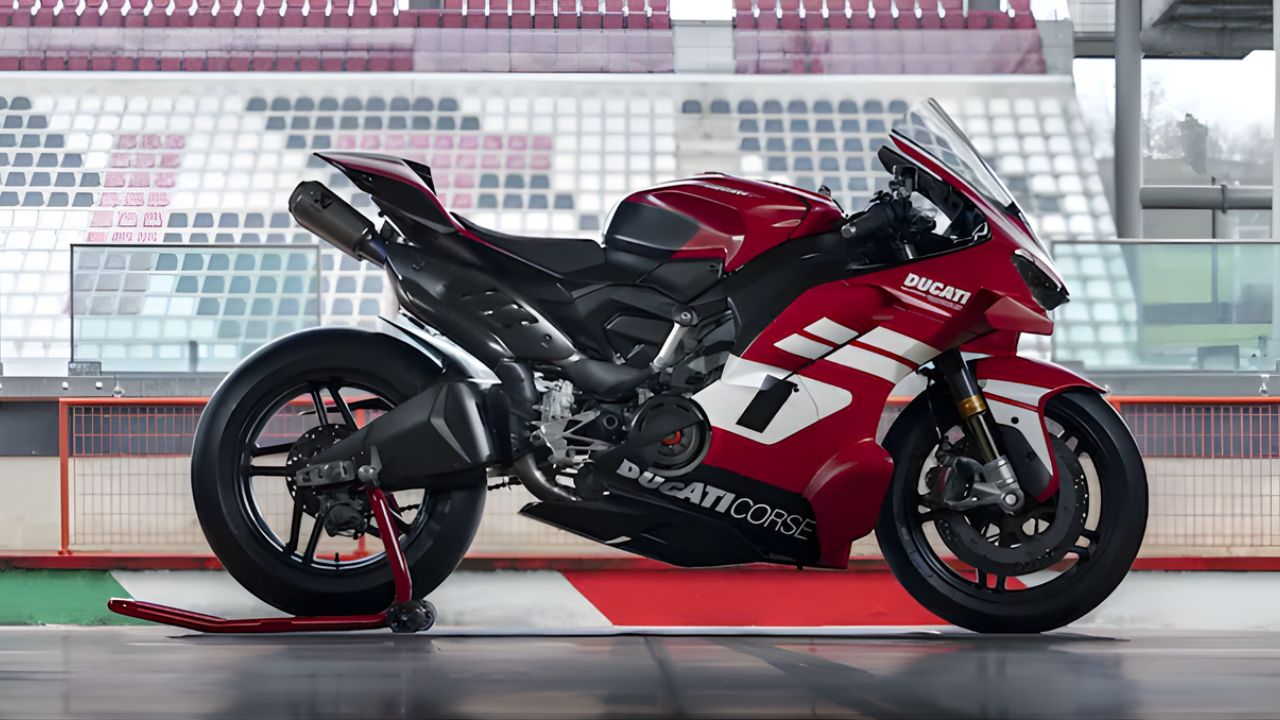
Ducati has introduced the Superleggera V4 Centenario as part of its tradition of marking major milestones with limited-edition motorcycles. Built to commemorate a 100-year achievement, the model reflects the brand’s focus on engineering precision, performance, and exclusivity.
Production is capped at 500 units, reinforcing its position as a collector-oriented machine while also showcasing Ducati’s most advanced technologies in a road-legal format.
Legacy
Ducati has consistently used special editions to highlight key moments in its history. The Centenario continues this approach, combining historical significance with modern engineering. Unlike standard production motorcycles, this model is designed in limited numbers to maintain exclusivity and to demonstrate the brand’s technical capabilities.
The Superleggera name, which translates to “super light,” has been associated with Ducati’s most weight-focused projects. In this version, the concept is extended further through the use of advanced materials and refined construction methods.

Engine
At the core of the Superleggera V4 Centenario is a 1,103 cc Desmosedici Stradale R engine. This engine is derived from Ducati’s racing program and has been adapted for road use while retaining high-performance characteristics.
In standard configuration, the engine produces 228 horsepower. With the addition of a race exhaust system, output increases to 247 horsepower. Torque is rated at 117 Nm, offering a balance between peak power and usable performance.
| Specification | Details |
|---|---|
| Engine Type | Desmosedici Stradale R |
| Displacement | 1,103 cc |
| Power (Standard) | 228 hp |
| Power (Race Exhaust) | 247 hp |
| Torque | 117 Nm |
To achieve these figures, Ducati has implemented lighter internal components, revised engine geometry, and precise desmodromic timing adjustments. The use of titanium in key areas further reduces weight while maintaining structural integrity.
Weight
Weight reduction is a central focus of the Superleggera V4 Centenario. The motorcycle features a carbon fibre frame, subframe, and wheels – elements that are uncommon in road-legal motorcycles at this level.

The result is a wet weight of approximately 173 kg without fuel. With the optional track kit, this figure can be reduced to 167 kg. This contributes to a power-to-weight ratio of 1.48 hp per kg, placing the motorcycle close to racing machine benchmarks.
The emphasis on lightweight construction is not limited to performance alone. It also influences handling, braking efficiency, and overall rider control.



Brakes
The Centenario introduces carbon-ceramic brake discs, a feature typically reserved for racing applications. This marks one of the first uses of such technology on a road-legal motorcycle.
Carbon-ceramic brakes offer consistent performance under high temperatures and reduce the effort required during braking. This can improve control when entering corners, particularly during high-speed riding. The system is designed to complement the motorcycle’s overall performance characteristics without compromising reliability.
Suspension
To manage its performance capabilities, the motorcycle is equipped with a high-specification suspension system. At the front, it uses an Öhlins NPX fork with carbon fibre sleeves. At the rear, a TTX36 GP shock absorber is installed.
Both components are fully adjustable, allowing riders to tailor the setup according to riding conditions or preferences. This level of adjustability is typically associated with track-focused motorcycles, though it remains accessible for road use.
The suspension setup supports stability and precision, particularly when combined with the lightweight chassis and aerodynamic enhancements.
Aerodynamics
The aerodynamic design of the Superleggera V4 Centenario is influenced by Ducati’s MotoGP experience. The motorcycle includes revised wings and side panels designed to generate downforce.
These aerodynamic elements function not only in straight-line conditions but also when the motorcycle is leaned into corners. This contributes to improved grip and stability, supporting consistent performance across different riding scenarios.
The design reflects a broader trend in high-performance motorcycles, where aerodynamics play a significant role alongside engine output and chassis design.
Design
The visual identity of the Centenario is defined by its “Rosso Centenario” paint scheme. This finish presents a deeper shade of red, referencing Ducati’s historical color palette while aligning with its current racing aesthetics.
In addition to the standard version, Ducati has introduced a Tricolore edition limited to 100 units. This variant adds another layer of exclusivity and visual distinction, appealing to collectors and enthusiasts seeking a rarer configuration.
The overall design remains consistent with Ducati’s approach – combining functional elements with a clear emphasis on heritage.
Gearbox
The gearbox has been refined to improve operational reliability during demanding riding conditions. One notable update is the prevention of accidental shifts into neutral during aggressive braking.
This adjustment addresses a specific challenge encountered in high-performance riding, particularly when downshifting into first gear. By improving shift accuracy, Ducati enhances rider confidence and control.
Exclusivity
With a production run limited to 500 units, the Superleggera V4 Centenario is positioned as a rare offering within Ducati’s lineup. The additional Tricolore variant, limited to 100 units, further emphasizes its exclusivity.
Such limited production not only increases desirability but also aligns with Ducati’s strategy of using special editions to showcase technological advancements. For buyers, the motorcycle represents both a performance machine and a collectible asset.
The Ducati Superleggera V4 Centenario brings together advanced engineering, lightweight construction, and racing-derived technology in a single platform.
Its combination of high power output, reduced weight, and specialized components places it among the most technically advanced road-legal motorcycles available.
While its exclusivity limits accessibility, it serves as a clear representation of Ducati’s engineering direction and its ongoing connection to motorsport.
FAQs
What engine does it use?
A 1,103 cc Desmosedici Stradale R engine.
How much power does it produce?
Up to 247 hp with race exhaust.
What is its weight?
Around 173 kg without fuel.
Is it limited production?
Yes, only 500 units are made.
What is special about brakes?
It uses carbon-ceramic brake discs.