
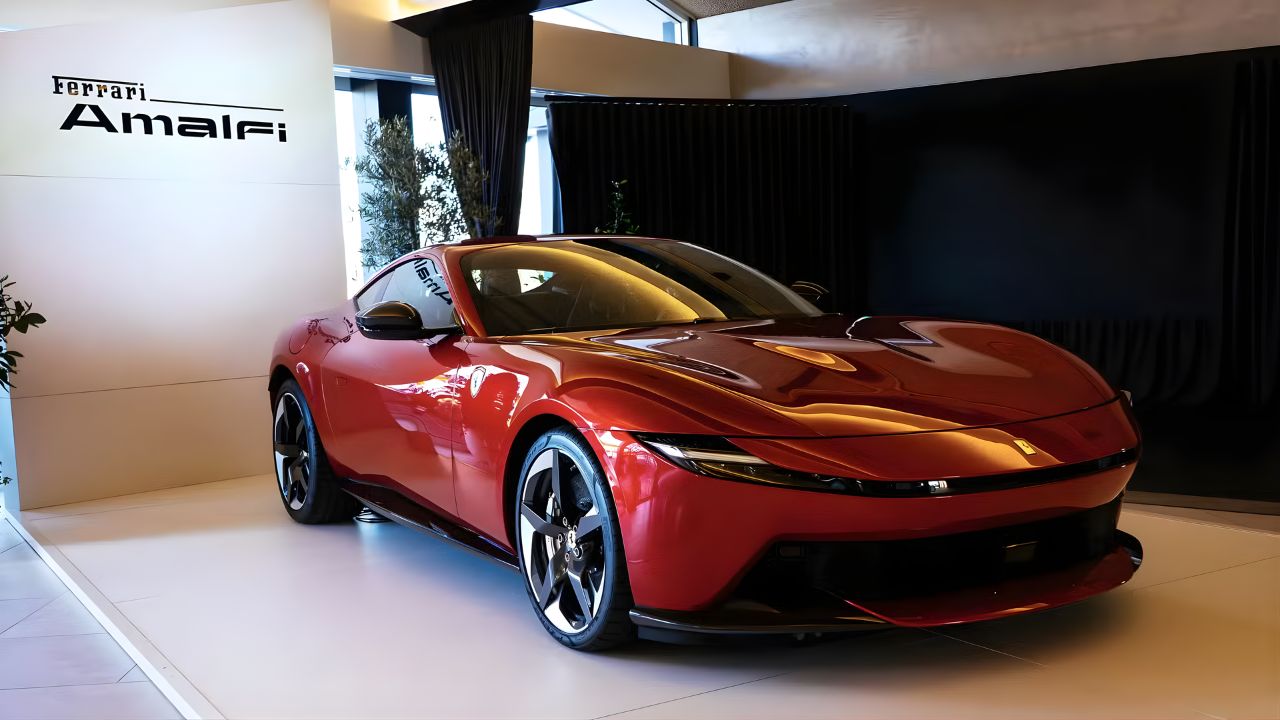
Ferrari has introduced its newest grand tourer, the Amalfi, in India at a starting price of Rs 5.59 crore (ex-showroom). Positioned as the brand’s most accessible model, the Amalfi replaces the Roma with a series of design, interior and performance updates.
While bookings are now open, deliveries are expected to begin after a waiting period of six to eight months.
With display units already reaching dealerships, the model offers a closer look at Ferrari’s evolving approach to luxury GT cars.
Overview
The Ferrari Amalfi is not an entirely new model but a heavily updated version of the Roma. It retains the core grand tourer proportions while incorporating revised styling elements, updated technology and improved mechanicals.

The car continues to follow Ferrari’s 2+ seating layout, combining performance with a degree of practicality, although the rear seats remain limited in usability.
Exterior
The Amalfi carries forward the Roma’s silhouette, defined by an elongated bonnet and a compact rear section. However, several design elements have been reworked.
At the front, the earlier body-coloured grille has been replaced with a layered design. The headlamps are now slimmer and feature integrated vents along their upper edges. A thin black strip connects the lights, replacing the more prominent grille seen on other Ferrari models.
Lower down, a wide air intake and a more pronounced splitter contribute to a sharper appearance. Subtle changes to the bonnet, including a smoother power bulge, enhance the overall visual balance.

At the rear, the design changes are more noticeable:
- Active spoiler integrated into the boot lid
- Slim tail lamps positioned lower and connected by a black strip
- Number plate relocated to the rear diffuser
These updates give the Amalfi a cleaner and more contemporary look compared to the Roma.




Interior
Ferrari has made significant revisions inside the cabin. The split cockpit layout seen in the Roma has been replaced with a cleaner dual-cowl design.
The centre console is now flatter, and the touchscreen has been repositioned horizontally within the dashboard. The earlier chrome-heavy gear selector has been replaced with a more understated unit, though it retains the signature H-pattern layout.
The steering wheel has also been redesigned, moving away from touch-sensitive controls to physical buttons. This includes controls for media and engine start, improving usability.
Key interior highlights include:
- Fully digital instrument cluster with vehicle and media data
- Optional passenger display for speed, RPM and infotainment
- Steering-mounted controls for multiple functions
- Large paddle shifters behind the wheel
Customisation remains a key aspect of the ownership experience. Buyers can choose from a wide range of leather finishes, colour combinations and carbon fibre trim options.
Seating
Like its predecessor, the Amalfi is configured as a 2+ seater. While rear seats are present, they offer limited legroom and are best suited for occasional use or additional storage.
This layout aligns with the car’s grand touring focus rather than practical family usage.
Engine
The Amalfi continues to use Ferrari’s 3.9-litre twin-turbo V8 engine, now updated for improved performance.
| Specification | Details |
|---|---|
| Engine | 3.9-litre twin-turbo V8 |
| Power Output | 631 bhp |
| Torque | 760 Nm |
| Gearbox | 8-speed dual-clutch |
The updated engine produces 11 bhp more than the Roma. Enhancements to the gearbox enable quicker shifts, contributing to improved performance.
Performance
Performance figures see marginal improvements over the Roma:
- 0-100 kmph in 3.3 seconds
- Faster 0-200 kmph acceleration by 0.3 seconds
A key technical update is the introduction of a brake-by-wire system paired with a new ABS Evo module. This setup removes the physical connection between the brake pedal and braking hardware, aiming to improve response and control.
Braking options include standard steel discs, with optional carbon-ceramic units for enhanced performance.
Technology
The Amalfi integrates multiple technology updates to improve both driving and passenger experience.
The digital instrument cluster serves as the primary display for key information, including navigation, climate control and vehicle diagnostics. It can also show feeds from the reverse camera or the optional 360-degree camera system.
The optional passenger display adds an interactive element, allowing occupants to monitor performance data and control certain features.
Delivery
Ferrari dealers in India have started accepting orders for the Amalfi. However, customer deliveries are expected to take between six and eight months from the time of booking.
Currently, only left-hand drive display units are available at dealerships. Customer-spec vehicles are yet to arrive in the country.
Positioning
The Amalfi sits at the entry point of Ferrari’s lineup in India, replacing the Roma. Despite being the most accessible model, it remains a premium offering with a focus on performance, design and personalisation.
The combination of updated styling, revised interiors and incremental performance improvements positions it as a refined evolution rather than a complete departure.
The Ferrari Amalfi represents a measured update to an already established grand tourer. By refining design elements, improving interior usability and enhancing performance, Ferrari has aimed to keep the model relevant in a competitive segment.
While the waiting period remains significant, the Amalfi continues to offer a blend of performance and luxury expected from the brand.
FAQs
What is the Ferrari Amalfi price in India?
Rs 5.59 crore ex-showroom.
What is the waiting period for Amalfi?
Around 6 to 8 months.
What engine does Amalfi use?
3.9L twin-turbo V8 engine.
How fast is Amalfi 0-100?
0-100 kmph in 3.3 seconds.
Is Amalfi a 4-seater?
It is a 2+ seating layout.