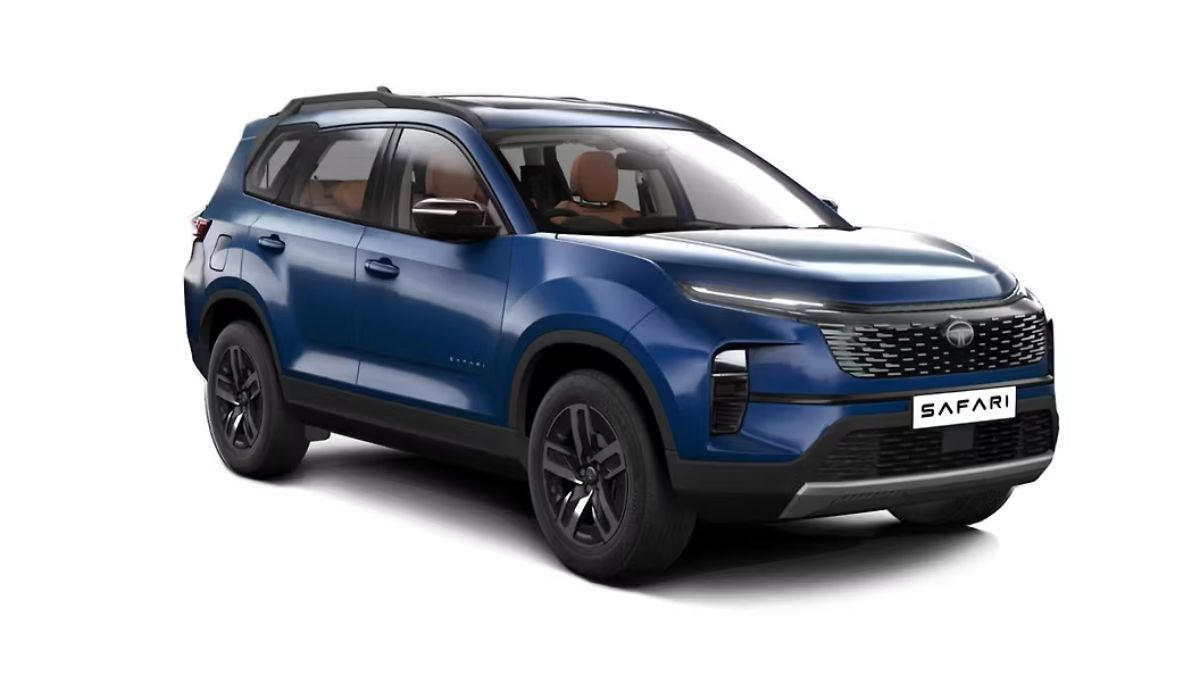
Tata Motors added a petrol engine to the Safari lineup earlier this year, giving buyers an alternative to the SUV’s diesel powertrain. With a 1.5-litre turbo-petrol engine and an automatic gearbox, the Safari petrol is aimed at buyers who want a more refined powertrain without giving up the SUV’s three-row practicality.
While Tata Motors has not published official fuel-efficiency figures for the petrol-powered Safari, a real-world test gives a better indication of what owners can expect in everyday driving.
Our test focused on the automatic version and covered both city and highway conditions. The results show a noticeable difference between urban and open-road driving, as expected from a large, relatively heavy seven-seat SUV.
Engine
The Tata Safari petrol uses a 1.5-litre, four-cylinder turbocharged petrol engine. It produces 168bhp and 280Nm of peak torque.
The engine is available with a six-speed manual gearbox, while the automatic version gets a six-speed torque-converter transmission.
For buyers considering the automatic model, the torque converter is an important part of the overall driving experience. It is designed to provide convenient gear changes in traffic while also allowing the engine to make use of its available torque during highway driving.
Despite the petrol Safari being on sale for several months, Tata Motors has not disclosed official mileage figures for the petrol-powered Safari and Harrier.
City
In our real-world test, the Safari petrol automatic returned 9.07kmpl in city driving.
The car’s multi-information display showed a slightly lower figure of 8kmpl. However, the displayed figure never fell below 8kmpl during the test.
This suggests that the MID may have a software-related lower limit rather than continuously displaying the actual fuel-efficiency figure.
The difference between the tested figure and the MID reading is relatively small, but it highlights why real-world testing can provide useful context. Fuel economy can vary with traffic conditions, driving style, road gradients, air-conditioning use and the number of occupants.
For a large petrol SUV used primarily in urban traffic, a city figure of around 9kmpl provides a reasonable indication of its fuel consumption.
Highway
The Safari petrol automatic performed considerably better during highway driving.
The SUV returned 14.92kmpl in our highway test, while the MID displayed 14.50kmpl.
The result shows the advantage of steady-speed driving for a turbo-petrol SUV. Highway conditions generally involve fewer stops and starts, allowing the engine and automatic transmission to operate more consistently.
The difference between the real-world figure and the MID reading was also relatively small in this case.
For buyers who frequently undertake longer journeys, the highway figure may be more relevant than the city result when estimating fuel costs.
Weight
The test vehicle was the top-spec Accomplished Ultra Red Dark variant.
It also had a seven-seat configuration and weighed 1,820kg. That is substantial for a petrol-powered SUV and helps put the mileage figures into perspective.
Vehicle weight has a direct influence on energy consumption, particularly during acceleration and frequent stop-and-go driving. A heavier SUV needs more energy to get moving, which can contribute to higher fuel consumption in city conditions.
The Safari’s size and three-row layout are among its practical strengths, but those characteristics also mean buyers should not expect small-car fuel economy from the petrol automatic.
Results
The test figures provide a simple comparison between city and highway conditions.
| Driving condition | Real-world mileage | MID mileage |
|---|---|---|
| City | 9.07kmpl | 8kmpl |
| Highway | 14.92kmpl | 14.50kmpl |
The difference between the two environments is significant. The highway figure is roughly 64% higher than the city test result.
That gap is understandable for a large SUV because urban driving involves more braking, acceleration and idling. Highway driving allows the vehicle to maintain a more consistent speed and reduces the energy lost through repeated acceleration.
Efficiency
The Safari petrol automatic’s fuel economy should be considered alongside its performance and size.
The 1.5-litre turbo-petrol engine produces 168bhp and 280Nm, giving the SUV a reasonably strong output for its segment. The six-speed automatic also prioritises ease of driving, particularly for buyers who regularly deal with congested roads.
However, anyone choosing the petrol automatic primarily for low running costs should consider the difference between city and highway consumption.
At 9.07kmpl in the city, frequent urban use could result in noticeably higher fuel expenditure. The 14.92kmpl highway result, meanwhile, makes the Safari better suited to longer journeys from a fuel-efficiency perspective.
Verdict
The Tata Safari petrol automatic returned 9.07kmpl in our city test and 14.92kmpl on the highway. The figures offer a useful real-world reference in the absence of an official mileage figure from Tata Motors.
The test vehicle’s 1,820kg weight, seven-seat configuration and 168bhp turbo-petrol engine should also be considered when comparing its fuel consumption with smaller SUVs.
For buyers who spend most of their time in city traffic, the roughly 9kmpl result is the more important number. Those who regularly drive on highways can expect better efficiency, with the test producing almost 15kmpl under those conditions.
Ultimately, the Safari petrol automatic combines a powerful turbocharged engine and three-row practicality with fuel consumption that varies considerably according to where and how it is driven.