Suzuki is planning to make essential advanced driver assistance systems, or ADAS, standard across its future models as part of a broader technology strategy for the coming decade.
The company says it wants to develop market-specific systems under what it calls a “Just-Right ADAS” approach. Rather than fitting every vehicle with the same collection of driver-assistance features, Suzuki intends to tailor the technology to individual markets, vehicles and driving conditions.
For Suzuki, which has a strong presence in the mass-market segment, the strategy could have implications beyond its premium models. The company is also looking at ways to reduce the cost and weight of ADAS hardware, potentially making selected safety features more accessible.
Among the functions Suzuki wants to make more widely available are autonomous emergency braking and lane-departure prevention.
Strategy
Suzuki’s approach is based on the idea that ADAS does not have to be identical across its entire model range.
Different vehicles have different purposes, price points and safety requirements. A compact hatchback used primarily in urban traffic, for example, may not need the same driver-assistance package as a larger vehicle designed for frequent highway use.
The company’s “Just-Right ADAS” strategy appears to reflect that distinction.
Instead of treating ADAS as a single package, Suzuki plans to develop systems that match local driving environments and customer requirements.
The approach could also help the company control costs. ADAS hardware can add sensors, cameras, processors and other components to a vehicle. Reducing the size, weight and cost of these systems could make wider adoption easier.
Maruti
Maruti Suzuki has already taken different approaches to ADAS across its Indian portfolio.
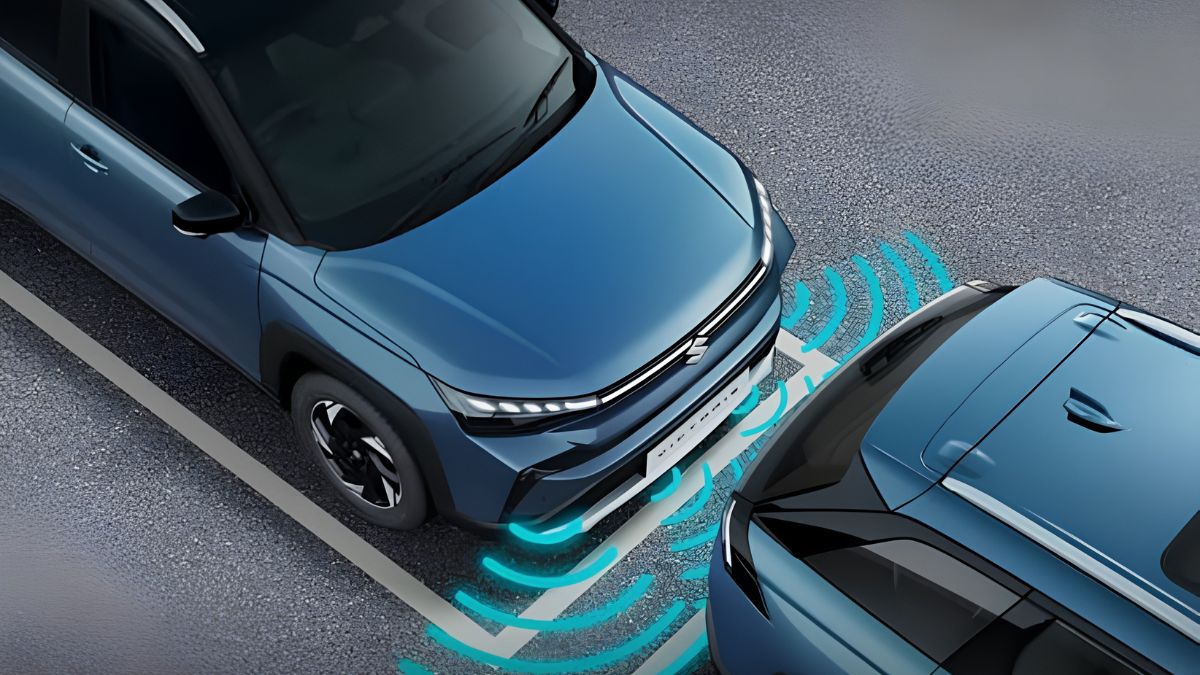
The Maruti Suzuki Victoris has a Level 2 ADAS system with a broad range of functions. These include automatic emergency braking, adaptive cruise control, lane keep assist and blind spot monitoring.
The Maruti Suzuki Baleno has also been offered with Level 2 ADAS, although its feature set differs. The system includes functions such as automatic emergency braking, lane keep assist, adaptive cruise control and lane departure prevention, with availability depending on the variant.
The Maruti Suzuki Brezza takes a different approach by offering active safety functions including blind spot warning, lane change alert and rear cross traffic alert rather than the same Level 2 package found on the Victoris and Baleno.
This existing variation provides an indication of how Suzuki’s “Just-Right ADAS” philosophy could work in practice.
Standardising essential ADAS does not necessarily mean every model will receive every available function.
India
India presents a particular challenge for driver-assistance technology.
Traffic conditions can vary considerably between cities, highways and rural roads. Motorcycles can move between lanes or through gaps, pedestrians may cross roads unexpectedly, lane markings can be inconsistent and vehicles can make sudden stops.
These conditions can make it difficult for automated systems to identify and respond to every situation consistently.
This is why Suzuki’s emphasis on market-specific development could be relevant to its future Indian models. Systems developed for relatively predictable highway environments may not behave in exactly the same way when faced with dense mixed traffic.
The effectiveness of ADAS therefore depends not only on how many functions a vehicle has, but also on how those systems perform under the conditions in which the vehicle is actually driven.
Features
Several ADAS functions could become more common as Suzuki expands the technology across its range.
Automatic emergency braking is one example. The system can monitor the road ahead and, under appropriate conditions, warn the driver or apply braking when it detects a potential collision.
Lane-departure prevention is another. Depending on the system, the vehicle can detect when it is unintentionally moving out of its lane and provide a warning or steering intervention.
Adaptive cruise control can maintain a selected speed while adjusting the vehicle’s speed in response to traffic ahead.
Other systems, such as blind spot monitoring and rear cross traffic alert, are designed to help drivers identify vehicles or other road users that may be difficult to see directly.
The availability and operation of these functions can vary between vehicles and markets.
Costs
For mass-market vehicles, cost remains one of the central considerations.
A manufacturer can technically add a large number of sensors and electronic systems to a vehicle, but doing so can increase the vehicle’s price.
Suzuki’s stated focus on reducing the cost and weight of ADAS hardware is therefore significant. If essential systems can be produced more efficiently, manufacturers may have more flexibility to offer them on lower-priced vehicles.
This could gradually change the equipment expected by buyers.
However, adding a feature to a car does not automatically make the system effective in every situation. Calibration, software development, sensor performance and testing are all important parts of ADAS development.
Expectations
Suzuki’s strategy could eventually influence how safety equipment is presented in the mass-market segment.
Today, buyers often have to move up a model range or select higher variants to access more advanced driver-assistance features. A wider rollout could make some functions more common across entry-level and mid-range vehicles.
But the definition of “standard ADAS” will matter.
If manufacturers focus on a smaller number of essential functions, buyers could see more widespread availability of technologies such as automatic emergency braking and lane-departure prevention. More advanced functions could remain dependent on the vehicle and market.
That would be consistent with Suzuki’s stated “Just-Right” approach.
Safety
The broader objective is not simply to increase the number of ADAS features listed in a vehicle’s specifications.
For Indian buyers, the more important question will be how reliably those systems operate in everyday traffic.
A system that works well on a clearly marked highway may encounter very different conditions in a crowded city. Motorcycles, pedestrians, road construction, inconsistent markings and unusual traffic movements can all affect the performance of driver-assistance technology.
Drivers should also remember that current ADAS systems are designed to assist rather than replace the driver. Even Level 2 systems require the driver to remain attentive and responsible for controlling the vehicle.
Future
Suzuki’s planned strategy suggests that ADAS could become a broader part of its future product range rather than remaining concentrated in higher-end models.
The company is looking at a combination of lower-cost hardware, market-specific development and selected essential functions. In India, Maruti Suzuki’s existing range already shows how different levels of driver assistance can be adapted to different vehicles.
The next step will be determining how far these technologies can move down the price range without compromising their usefulness.
If Suzuki can combine affordable hardware with systems that are appropriately calibrated for local traffic conditions, more Indian buyers could eventually encounter ADAS as part of the basic safety equipment on a car rather than as a feature reserved for expensive variants.