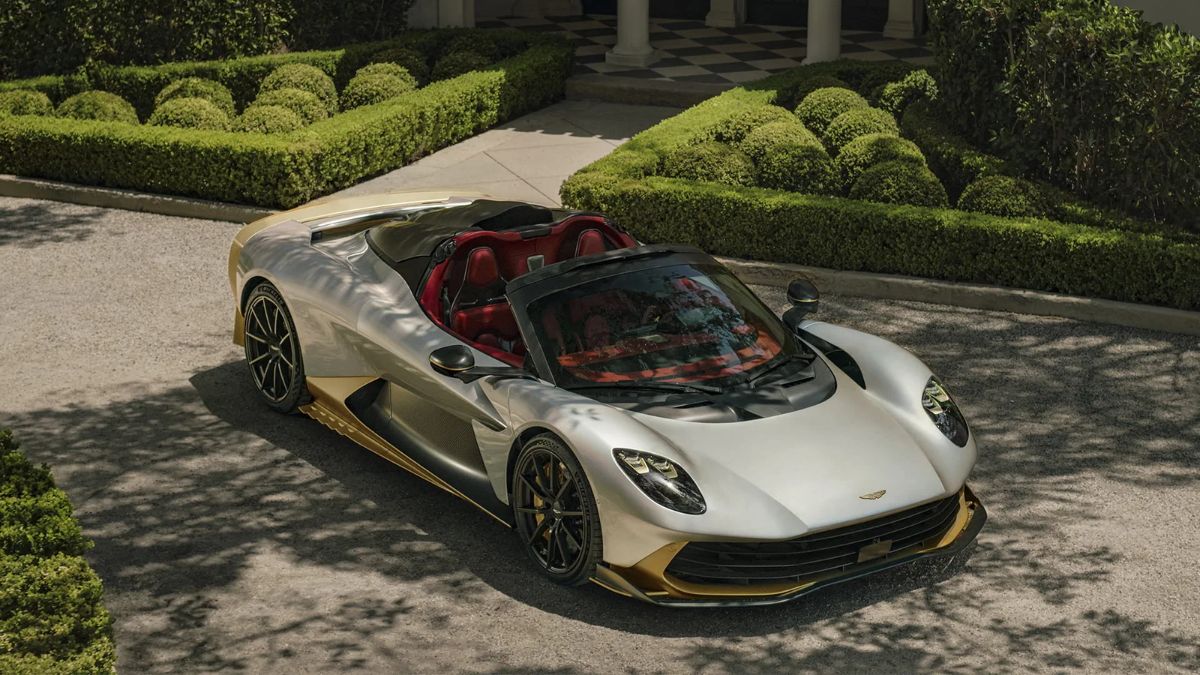
Aston Martin has expanded its high-performance supercar lineup with the new Valhalla Spider, an open-top version of the Valhalla hybrid supercar. Combining a powerful twin-turbocharged V8 engine with three electric motors, the new model delivers a remarkable 1,064bhp and 1,100Nm of torque. It retains the coupe’s core performance hardware while introducing roof options and aerodynamic changes designed specifically for open-air driving.
The Valhalla Spider brings together the appeal of a convertible and the engineering of a modern hybrid supercar. With a claimed 0-100kmph acceleration time of just 2.5 seconds and a top speed of 350kmph, it is designed to deliver serious performance on both roads and race circuits.
Design
The Valhalla Spider stays close to the coupe’s styling, retaining its low-slung proportions, sculpted carbon-fibre bodywork and distinctive dihedral doors. However, removing the fixed roof has required several changes to the body and airflow management systems.
Buyers can choose between a standard fabric roof and an optional carbon-fibre hardtop. The fabric roof can be operated at speeds of up to 200kmph, giving drivers the flexibility to enjoy open-top motoring without having to stop. The hardtop, meanwhile, allows the car to reach its claimed maximum speed of 350kmph.
Aston Martin also states that the Spider can achieve its maximum speed with the roof removed. This highlights the work that has gone into managing airflow around the cabin and maintaining stability at extreme speeds.
The roof options give the Valhalla Spider two distinct personalities. With the roof fitted, it offers the enclosed feel of a traditional supercar. With the roof removed, it delivers a more direct connection to the engine sound and surrounding environment.
Aerodynamics
Taking the roof off a high-performance car involves more than changing its body structure. Engineers must account for airflow around the occupants, engine intake and rear bodywork, particularly when the car is travelling at high speeds.
The Valhalla Spider addresses these challenges with a revised roof scoop positioned 35mm higher than the unit on the coupe. A new wind deflector also helps control airflow around the cabin while directing air towards the engine intake.
The deflector folds into three sections and can be stored in newly created 15-litre compartments in the side sills. This arrangement provides a practical storage solution without requiring a separate space for the removable component.
Aston Martin has also revised the carbon-fibre dihedral doors. The new doors feature a frameless design and an updated opening mechanism to accommodate the Spider’s configuration.
These adjustments are intended to preserve the car’s performance-focused character while making open-top driving more manageable. They also demonstrate the additional engineering required to turn a fixed-roof supercar into a convertible without compromising its fundamental abilities.
Powertrain
At the heart of the Valhalla Spider is the same plug-in hybrid powertrain used in the coupe. It combines a 4.0-litre twin-turbocharged V8 petrol engine with three electric motors and a battery pack.
The V8 produces 816bhp, while the electric motors contribute a further 247bhp. Together, the system delivers a total output of 1,064bhp and maximum torque of 1,100Nm.
Here is a breakdown of the key powertrain figures.
| Specification | Aston Martin Valhalla Spider |
|---|---|
| Engine | 4.0-litre twin-turbo V8 |
| Hybrid system | Three electric motors |
| Combined power | 1,064bhp |
| Maximum torque | 1,100Nm |
| Transmission | Eight-speed dual-clutch |
| Drivetrain | All-wheel drive |
| 0-100kmph | 2.5 seconds |
| Claimed top speed | 350kmph |
The engine alone produces 204bhp per litre, a figure that reflects its high-performance design. The electric motors add power while supporting the car’s all-wheel-drive system and electronic control functions.
Two electric motors drive the front wheels, while the third is integrated into the eight-speed dual-clutch transmission. This layout allows the car to send power to all four wheels and use electric torque vectoring at the front axle.
At the rear, an electronic differential helps manage power delivery. Together, these systems are designed to improve traction, cornering performance and stability when the driver accelerates out of bends.
The plug-in hybrid setup also gives the Valhalla Spider a degree of electric driving capability, although its main purpose remains delivering high levels of performance rather than prioritising efficiency.
Performance
The Valhalla Spider’s headline figures place it firmly in the extreme-performance supercar category. Aston Martin claims the car can accelerate from 0 to 100kmph in 2.5 seconds, while its top speed is rated at 350kmph.
Those figures put substantial demands on the chassis, brakes, tyres and electronic systems. A powerful engine alone cannot deliver consistent performance at these speeds, so Aston Martin has retained the coupe’s core engineering package while recalibrating selected systems for the open-top configuration.
The car uses a carbon-fibre monocoque developed with input from Aston Martin Performance Technologies, the company’s Formula 1-linked engineering division. This lightweight structure is designed to provide the rigidity needed for precise handling and high-speed stability.
The suspension package includes pushrod front suspension and adaptive dampers. Carbon-ceramic brakes provide the stopping power required to manage the car’s performance, particularly during repeated hard braking on a circuit.
Aston Martin has also recalibrated the active aerodynamics and electronic stability control to account for changes in airflow when the roof is removed. These systems play an important role in keeping the car predictable as speed and driving conditions change.
Downforce
Aerodynamic performance is a major part of the Valhalla Spider’s engineering. Aston Martin claims the car can generate more than 600kg of downforce at 240kmph in Race mode.
Downforce presses the car towards the road, helping the tyres maintain grip during fast cornering. It becomes particularly important on a circuit, where drivers need confidence when braking, changing direction and accelerating through high-speed bends.
Generating substantial downforce in an open-top car presents additional challenges because removing the roof changes the way air moves around the vehicle. The Spider’s revised aerodynamic components and electronic systems are intended to address those differences.
The claimed downforce figure also highlights the car’s track-focused ambitions. Although the Spider offers the enjoyment of open-air driving, its engineering remains centred on delivering the performance expected from a flagship hybrid supercar.
Interior
Inside, the Valhalla Spider retains the coupe’s driver-focused cabin. The layout is designed to keep the driver connected to the car, with an emphasis on performance-oriented controls and materials.
The Spider comes with new carbon-fibre Touring Seats as standard. These seats are intended to improve comfort and make entering and exiting the vehicle easier, particularly when the roof is fitted.
Buyers who prefer the original carbon-fibre seats can still choose them at no additional cost. This gives customers the option to prioritise the Touring Seats’ accessibility or retain the more overtly performance-focused seating design.
Aston Martin’s Q personalisation division will also offer a range of customisation options. These include bespoke exterior colours, distinctive liveries and different interior materials.
Such options allow buyers to tailor the car to their preferences, from relatively understated finishes to more distinctive specifications. In the high-end supercar segment, personalisation can be an important part of the ownership experience.
Launch
The Aston Martin Valhalla Spider is scheduled to make its public debut at the 2026 Concours at Wynn Las Vegas. Deliveries are expected to begin in the third quarter of 2027.
Aston Martin has not yet announced pricing, and details about a possible India launch remain unavailable. Buyers interested in the model will therefore need to wait for further information about market availability and final specifications.
The expected delivery timeline also means the Spider will enter the market as part of the next phase of Aston Martin’s hybrid performance strategy. Its combination of a high-output combustion engine, electric assistance and open-top design reflects the broader shift towards electrified powertrains in the supercar segment.
The Valhalla Spider retains the core strengths of the coupe while adding a more immersive driving experience. Its 1,064bhp output, 1,100Nm of torque and claimed 350kmph top speed make it an ambitious addition to Aston Martin’s lineup. The final appeal will depend on its pricing, availability and how effectively its open-top design preserves the performance of the original car.
FAQs
How much power does the Valhalla Spider produce?
It produces a combined 1,064bhp from its V8 engine and three electric motors.
What engine does the Valhalla Spider use?
It uses a 4.0-litre twin-turbocharged V8 plug-in hybrid powertrain.
How fast is the Valhalla Spider?
Aston Martin claims 0-100kmph in 2.5 seconds and a top speed of 350kmph.
When will Valhalla Spider deliveries begin?
Deliveries are expected to begin in the third quarter of 2027.

Has Aston Martin announced its price?
No, pricing has not yet been announced.