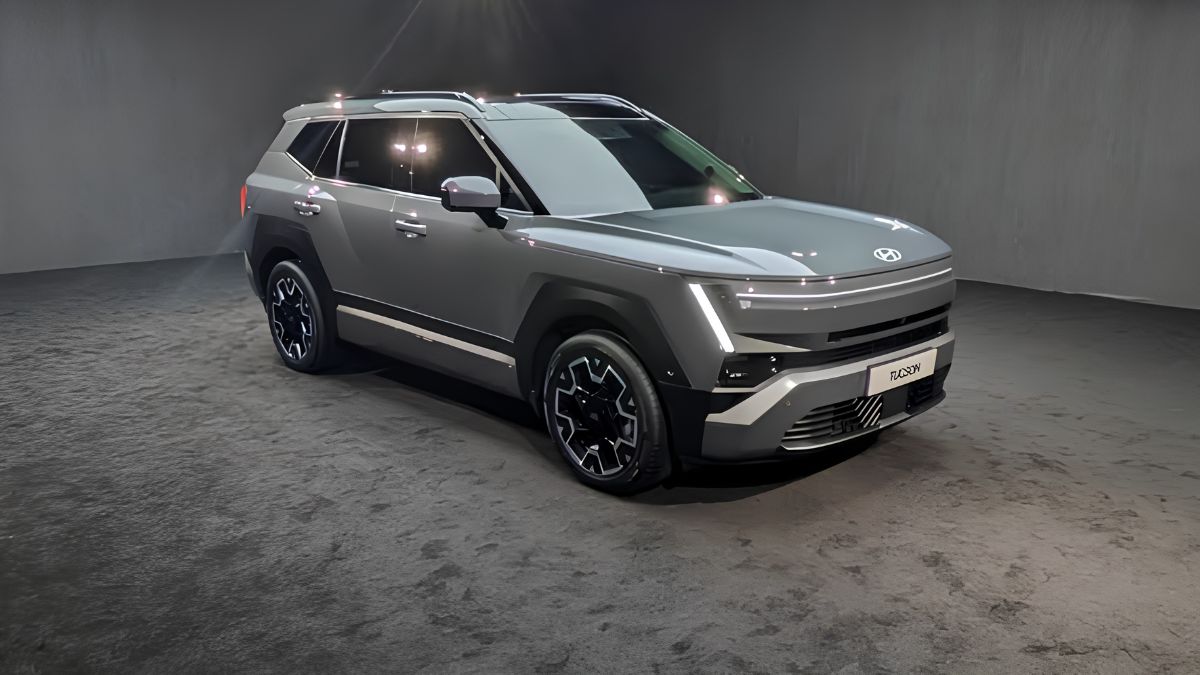
Hyundai has unveiled the fourth-generation Tucson, introducing a redesigned exterior, a more modern interior and updated hybrid technology. The new SUV made its global debut in New York and is expected to reach South Korea later this year before arriving in North America, Europe and other markets during 2027.
The latest Tucson brings changes across the vehicle rather than relying on a simple styling update. Hyundai has increased its dimensions, redesigned the dashboard and added newer infotainment technology. Powertrain choices will include petrol, hybrid and plug-in hybrid options, although availability will vary by market.
Design
The new Tucson has grown in size compared with its predecessor, with Hyundai using the additional dimensions to create more room inside the cabin.
For the long-wheelbase version, the SUV measures 4,700mm in length, 1,905mm in width and 1,685mm in height. That makes it 60mm longer, 40mm wider and 20mm taller than the outgoing model.
The wheelbase has also increased by 30mm to 2,785mm.
| Specification | New Tucson |
|---|---|
| Length | 4,700mm |
| Width | 1,905mm |
| Height | 1,685mm |
| Wheelbase | 2,785mm |
The larger footprint gives Hyundai additional space to work with for the passenger compartment. The company says the increased dimensions have been used to improve cabin space.
The exterior design is also entirely new, marking a clear visual change for the fourth-generation SUV.
Cabin
Inside, Hyundai has adopted a cleaner dashboard design built around a two-layer instrument panel.
Rather than placing every function behind a touchscreen, the company has retained physical controls for frequently used features such as climate and audio functions. This gives the cabin a combination of digital displays and conventional controls.
Depending on the market and trim level, the Tucson will be available with either a 17-inch or 12.9-inch central touchscreen. A 9.9-inch display is also part of the interior technology package.
The larger screen options give the new SUV a substantial digital interface, while the physical controls provide direct access to commonly used functions.
Hyundai has not yet confirmed that every specification will be available in every market. Equipment levels are expected to differ depending on the country and variant.
Hybrid
The updated hybrid powertrain is one of the major changes for the new Tucson.
In the Korean specification, the hybrid combines a 1.6-litre turbocharged petrol engine with electric motors and produces up to 245bhp.
The combination is designed to provide the performance of a petrol engine with electric assistance. Hybrid specifications, equipment and output can vary between markets, so figures for one region should not automatically be applied to another.
Hyundai will also offer conventional petrol power in selected markets, giving buyers an alternative to the electrified versions.
The company has not positioned the Tucson as an exclusively electrified SUV. Instead, the new generation will continue with a range of powertrain options tailored to different markets.
PHEV
A plug-in hybrid version will also be available in selected markets.
The Tucson PHEV combines the 1.6-litre turbo-petrol engine with a 17.1kWh battery and has a claimed system output of 292bhp.
Hyundai says the plug-in hybrid can travel up to 81km on electric power alone under the applicable testing cycle. The vehicle also supports a 7.2kW onboard charger.
The larger battery allows drivers to use electric power for shorter journeys before the petrol engine becomes necessary. Actual electric range will depend on factors such as driving conditions, temperature, speed and the relevant testing standard.
The PHEV will not be offered universally, with availability depending on individual markets.
Technology
Technology is a major part of the new Tucson’s cabin redesign.
The available large central touchscreen provides a more prominent interface for infotainment and vehicle functions. The 9.9-inch display adds another digital element to the dashboard.
At the same time, Hyundai has retained physical controls for functions that drivers regularly adjust. This approach gives the cabin a mixture of touchscreen technology and conventional switches rather than moving every operation onto the central display.
The exact technology package will depend on the market and trim level.
Hyundai is also expected to offer different equipment combinations across regions, meaning specifications announced for the global debut may not represent the final version sold in every country.
Space
The increase in the Tucson’s dimensions is significant because the additional length and wheelbase can provide more room for passengers.
The 30mm wheelbase increase to 2,785mm gives Hyundai additional space between the front and rear axles. Combined with the wider and taller body, this creates more room for the interior design team to work with.
For buyers considering a family SUV, interior packaging can be just as important as engine output or exterior styling. Hyundai’s larger dimensions therefore form an important part of the fourth-generation model’s changes.
Exact luggage capacity and market-specific interior configurations will depend on the version sold in each region.
Launch
The new fourth-generation Tucson made its world premiere in New York.
Hyundai plans to launch the SUV in South Korea later in 2026, followed by North America, Europe and other markets during 2027.
The timing means customers in different countries will not necessarily see the new Tucson at dealerships at the same time. Powertrain choices will also differ by market, with petrol, hybrid and plug-in hybrid versions offered according to local requirements and Hyundai’s regional product strategy.
Pricing and detailed specifications for individual markets are expected to be announced closer to each market’s launch.
The new Tucson therefore represents a substantial update to Hyundai’s global SUV lineup, combining a larger body with a redesigned cabin, updated hybrid technology and a wider range of digital features. For buyers waiting for the 2027 model, the key differences will be the new design, increased dimensions, updated interior and electrified powertrain options, with final equipment depending on the market.