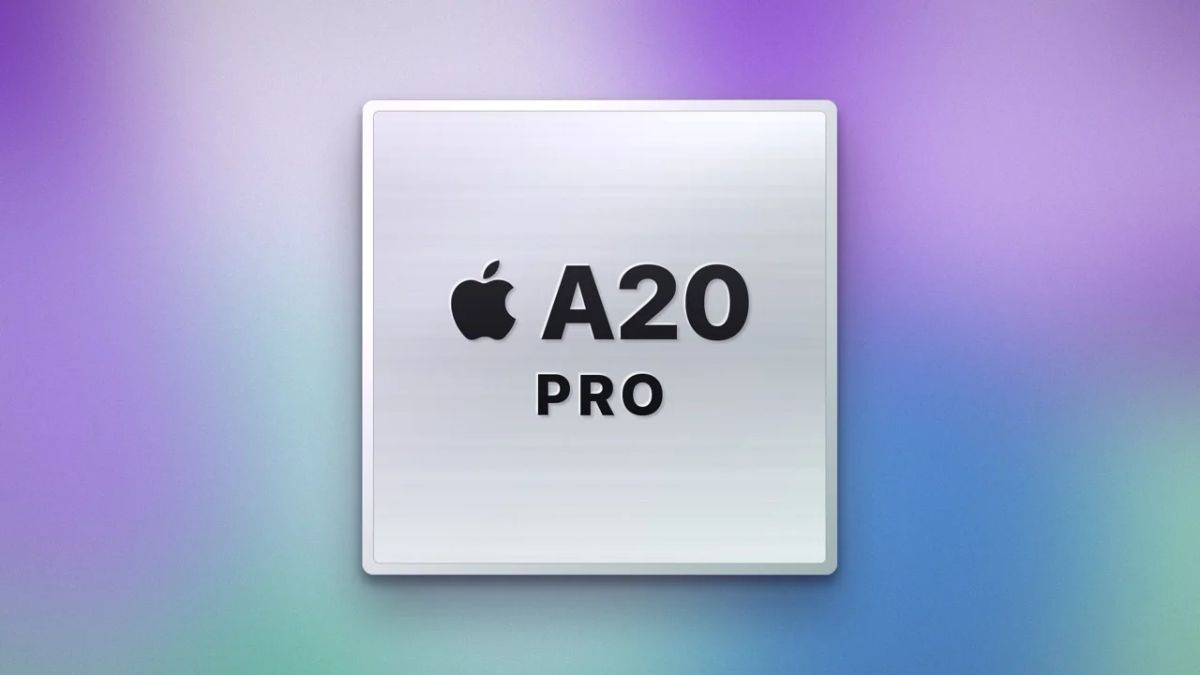
Apple has introduced its next-generation A20 Pro chipset, designed for the iPhone 18 Pro series and the company’s first foldable smartphone, the iPhone Duo. The chip succeeds the A19 Pro found in the iPhone 17 Pro lineup and brings changes to processing performance, graphics, memory bandwidth and on-device artificial intelligence.
Built using a new 2-nanometre manufacturing process, the A20 Pro is positioned as a major step forward in Apple’s custom silicon strategy. The company says the chip can deliver up to 40% higher performance than its predecessor while also improving sustained performance and AI processing.
Architecture
The A20 Pro is manufactured using TSMC’s 2nm process technology. Moving to a smaller process node allows Apple to increase transistor density while potentially improving power efficiency and performance.
The chip features a six-core CPU and a new seven-core GPU, with integrated Neural Accelerators for AI-related workloads.
Apple claims the A20 Pro is up to 40% faster than the A19 Pro. The company also says memory bandwidth has increased by 50%, which could help the processor handle demanding applications that frequently move large amounts of data between memory and the computing cores.
These improvements are particularly relevant for intensive games, computational photography and AI features that increasingly run directly on smartphones.
AI
Artificial intelligence is one of the main areas of focus for the A20 Pro.
The chipset features a dual 16-core Neural Engine configuration, giving it 32 Neural Engine cores in total. Apple says this provides up to twice the AI processing capability of the A19 Pro.
The additional processing capacity is intended to support on-device AI tasks without requiring every request to be sent to cloud servers. This can be useful for applications where response times, privacy or the ability to work without a constant internet connection matter.
The A20 Pro is also designed to support Apple Intelligence features and the latest Siri experience. Computational photography is another potential beneficiary, as modern smartphone cameras increasingly rely on machine learning for image processing.
For users, the hardware changes may be less visible than the features they enable. AI processing can operate behind the scenes, improving photography, voice recognition, text functions and other smartphone tasks.
Cooling
Apple has also changed how the A20 Pro is packaged inside its latest devices.
The new design places the silicon die alongside the memory rather than positioning the memory directly in the chip’s thermal path. Apple says this allows the A20 Pro to connect directly to a next-generation vapour chamber.
The redesigned cooling system is particularly important for sustained workloads. A processor can deliver high peak performance for short periods, but temperatures can force it to reduce its speed during longer gaming or AI sessions.
Apple says the vapour chamber in the iPhone 18 Pro models has three times the surface area of the previous generation.
The company also claims that the new thermal design contributes to up to a 40% improvement in sustained performance. Actual results will depend on the workload, device design and operating conditions.
Connectivity
The A20 Pro is designed to work alongside Apple’s N1 wireless networking chip and C2 cellular modem.
The N1 chip supports Wi-Fi 7, Bluetooth 6 and Thread, covering wireless networking, device connectivity and smart-home applications.
The C2 modem handles cellular connectivity in compatible devices.
Separating these functions across dedicated components allows the main application processor to focus on computing workloads while specialised chips manage communications.
This approach also reflects the broader trend toward smartphones using several custom processors rather than relying on a single chip for every task.
Performance
The combination of a 2nm manufacturing process, additional AI hardware, higher memory bandwidth and improved cooling gives the A20 Pro several areas of potential advantage over the A19 Pro.
The claimed 40% performance improvement should not be interpreted as a universal increase across every application. Processor performance varies depending on the software and whether a workload is CPU-, GPU- or AI-intensive.
The 50% increase in memory bandwidth could be particularly useful for graphics-heavy applications and AI workloads, where large quantities of data need to be processed quickly.
Likewise, the claimed improvement in sustained performance could matter more to gamers and users running demanding applications for extended periods than to people performing everyday tasks such as messaging or browsing.
Devices
The A20 Pro is expected to power the iPhone 18 Pro lineup and Apple’s first foldable smartphone, the iPhone Duo, according to the information provided.
That would give the chip a role beyond Apple’s conventional flagship phones. A foldable device can place different demands on its processor and thermal system, particularly if users take advantage of its larger display for multitasking.
The A20 Pro’s combination of performance and thermal improvements could therefore be important for both device categories.
Overall, the A20 Pro represents Apple’s push toward more powerful custom silicon with greater emphasis on local AI processing. Its 2nm architecture, expanded Neural Engine, higher memory bandwidth and redesigned thermal system are aimed at improving both peak capability and longer-term performance. The significance of those changes will ultimately depend on how Apple’s software and applications use the additional processing capacity.